Quick answer: a virtual assistant for small business support makes sense when the same admin keeps landing on you, work you’ve already said yes to keeps slipping, and you can name a handful of tasks someone else could own. You don’t need a perfect list or a big budget. You need a few clear, repeatable jobs and someone accountable for making the arrangement work.
Why “am I ready?” is the right first question
Most owners don’t wake up one morning and decide to hire a virtual assistant. It creeps up on them. The inbox gets a bit longer. Invoices go out a few days late. A Sunday afternoon disappears into bookings and spreadsheets, and then another one does.
Plenty of small business owners across Australia sit in that space for months, sometimes years, because they’re not sure the business is “big enough” for help. Honestly, size isn’t the test. Readiness is. Below are seven signs worth checking against your own week, plus a few signs you might want to wait.
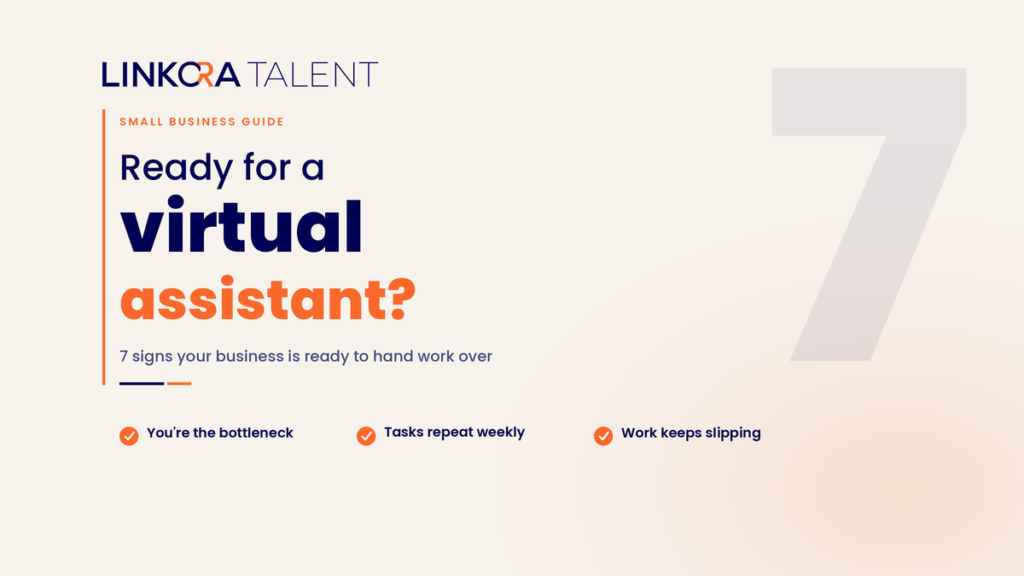
7 signs your small business is ready for a VA
1. You’re the bottleneck for work that doesn’t need you
If quotes, replies and approvals all wait on you, the business moves at the speed of your inbox. Some of that genuinely needs your judgement. A lot of it doesn’t. When routine admin is holding up the work that only you can do, that’s the clearest sign there is.
2. The same tasks repeat every week
Look at the last fortnight. Inbox triage, calendar juggling, data entry, follow-up emails, document formatting. If those jobs come round on a schedule, they can be written down. And if they can be written down, they can be handed over. Our guide on where a VA fits, and where they don’t is a useful filter here.
3. Things keep slipping, not because they’re hard
Overdue invoices. Leads that never got a reply. Supplier emails sitting unread. These aren’t difficult jobs. They’re just nobody’s job, so they drift. A VA who owns them end-to-end fixes the drift, not just the workload.
4. You’re doing admin after hours
Evenings and weekends are often where the admin ends up. That works for a while. Over a year it wears people down, and it usually means the business is relying on the owner’s spare time as its back office.
5. A local hire doesn’t stack up for the hours you need
Maybe you need 10 or 20 hours of admin a week, not a full-time role. Hiring locally for part-time admin can be hard to justify once you factor in recruitment and oncosts, and reception or existing staff may already be stretched. This is often where a virtual assistant in Australia’s business hours starts to make sense.
6. You can describe what a good month looks like
This one surprises people. If you can say “a good month means invoices out by the 3rd, enquiries answered same day and the calendar never double-booked”, you already have the bones of a role. That outcome becomes the brief. We’ve written a step-by-step guide to writing a VA role brief that actually works.
7. You’re willing to invest a few weeks up front
A VA isn’t a switch you flip. The first four to six weeks need some of your time: walking through processes, granting access, answering questions and checking early work. If you can carve out that time, you’re ready. If you can’t, the arrangement will struggle no matter who you hire. There’s more on that in why the first six weeks decide everything.
Signs you might want to wait
Readiness cuts both ways. A VA probably isn’t the right move yet if:
- You can’t name even three tasks you’d hand over.
- Every process lives only in your head and you have no time to explain any of it.
- The work needs someone physically on site, or it involves clinical or professional judgement that has to stay with you.
- You’re hoping a VA will “just figure out” what the business needs.
None of these are permanent. They just mean the groundwork comes first. Often a short scoping conversation is enough to turn a vague feeling into a role.
What a virtual assistant for small business usually handles
Every business is different, but the work tends to fall into a few familiar areas:
- Admin and operations: inbox triage, calendar management, document prep, data entry, meeting notes.
- Customer service: first-line email replies, follow-ups, booking coordination, keeping CRM records current.
- Marketing support: scheduling social posts, formatting content, keeping lead lists clean.
- Clinic admin: bookings, reminders and recall lists. Admin only, with clinical decisions staying with your practitioners.
- Bookkeeping admin: invoice chasing, receipt matching and the paperwork around your bookkeeper’s work.
A role can mix tasks from more than one area. It doesn’t need to be tidy before you start.
Readiness checklist: before you start looking
Run through this quickly. If you can tick most of it, you’re in good shape.
- I can list at least three tasks I’d hand over.
- I know roughly how many hours a week the work takes.
- I know which tools and systems the VA would use.
- I know what stays with me (decisions, approvals, anything sensitive).
- I can describe a good month in one or two sentences.
- I can set aside time for check-ins over the first six weeks.
Choosing how to hire once you’re ready
Being ready is step one. Step two is picking a model. A freelance marketplace gives you a profile and leaves the screening, training and managing with you. A recruiter finds a candidate and usually steps back once they start. A managed VA service shapes the role with you, matches a VA from its own team, runs onboarding and stays accountable afterwards. Our breakdown of marketplace, agency or managed service covers the trade-offs in more detail.
Whichever way you go, look past the hourly rate. Turnover is what quietly undoes offshore support, so ask how VAs are paid, supported and kept. Our piece on the real cost of offshore support explains why cheap so rarely lasts.
How Linkora helps when you’re ready
Linkora Talent is an Australian-owned, Queensland-based managed VA service. If you’re looking for a Queensland VA agency, or you want to hire a VA Queensland and interstate businesses can rely on, the process is the same. We define the role with you, you meet the proposed VA before anything is signed, and our team runs four to six weeks of structured onboarding. After that, we stay involved with regular check-ins.
We work with small businesses and SMEs, start-ups, healthcare practices and clinics and cybersecurity firms. VAs work Australian business hours as standard, and there’s no separate placement fee.
FAQs
How do I know if my small business needs a virtual assistant?
If routine admin keeps landing on you, tasks keep slipping, and you can name a few repeatable jobs someone else could own, you’re likely ready. Business size matters less than having clear work to hand over.
How many hours should a small business start with?
Many roles start around 10–20 or 20–30 hours a week, and some grow into full-time. Working out the right number is part of scoping.
Do I need documented processes before I hire a VA?
It helps, but you don’t need a full manual. A short role brief and a willingness to walk your VA through things in the first few weeks is enough to start. Many VAs help write the process notes as they learn.
What shouldn’t I hand to a VA?
Final decisions, approvals, and anything that needs clinical or professional judgement should stay with you. Scope it clearly in writing from the start.
Can a virtual assistant work Australian business hours?
Yes. With Linkora, Australian business hours are the standard and are agreed when we scope the role.
Think you’re ready?
If a few of these signs sound like your week, book a free strategy call with Linkora. It takes about two minutes to tell us what you need, and you don’t have to sign anything to get a price. Still weighing it up? Browse more guides on our insights page.